
This year has seen the centenary of the Spelling Society, formerly the Simplified Spelling Society, and inevitably there has been a lot of comment in the press, mostly uninformed criticism of anyone (particularly John Wells, as its President) who supports even a modicum of reform as an abandonment of “standards”.
Proposals for reforming English spelling go back way before the Spelling Society was founded, but the momentum for change increased in the 20th century. Robert Bridges, as Poet Laureate, had enough clout to persuade Oxford University Press to reprint a series of his essays with ever increasing numbers of reforms, which included new or adapted letter shapes for particular sounds; Bernard Shaw went a step further, by leaving an immense amount of money in his will for the formulation of a new writing system for English, which would not be based on the Roman alphabet, and would not simply be a new form of shorthand. He wrote several letters to The Times on this subject in the 1930s and 1940s, using the economic argument that the only way of achieving success was to persuade politicians of the saving in terms of both money and time: an alphabet that contained a single symbol for each of the phonemes of English, thus obviating the necessity for digraphs and eliminating ambiguities (e.g. row, lead), would use up less space on the page, therefore less paper, therefore be cheaper; and quicker to both write and read, therefore saving much time, and therefore money. (The elimination of superfluous hard signs in Russian is said to have reduced the length of “War and Peace” by over 90 pages!)
Shaw’s will was overturned in the courts, but a competition to devise a new alphabet was held, and the winner was rewarded not only with a cash prize, but with the satisfaction of seeing his alphabet published by Penguin in a dual-text edition of “Androcles and the Lion” (1962). (One of the adjudicators, who also helped refine the winning entry, was Peter MacCarthy, who lectured in phonetics at several universities, and was my external examiner when I took the undergraduate course in phonetics at Edinburgh in the 1960s.) Right enough, this alphabet did save space – roughly one third of the page containing the Shaw alphabet version is blank, but there was no way that it could ever become a success: the Roman alphabet has now more-or-less conquered the world, and to expect anyone, native speaker or, perhaps especially, foreign learner to take the trouble to learn this new writing system is beyond belief.
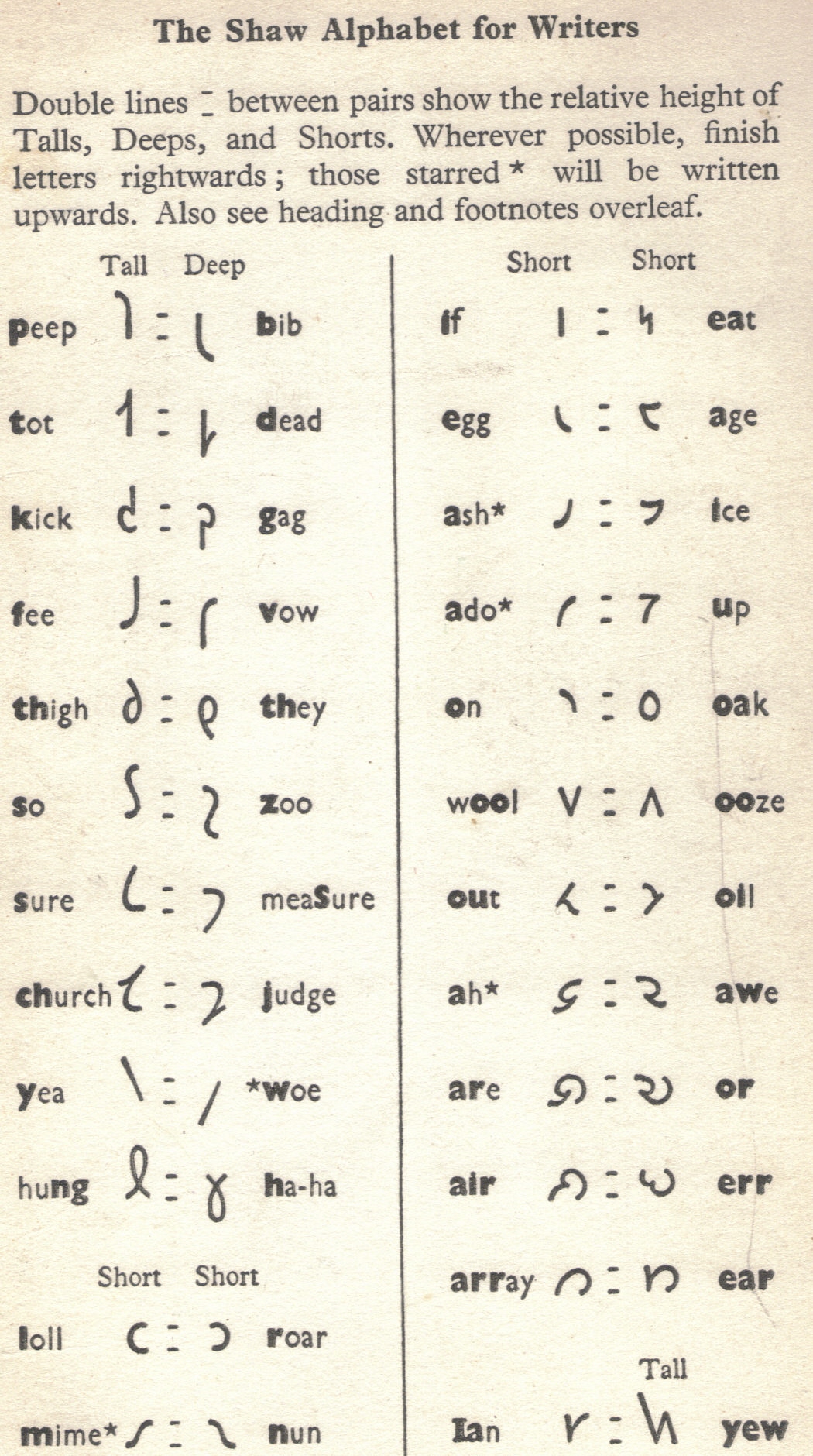
Some simple reforms would be easy: the initial w and k of words such as wrong or knife could be dropped with no problem: they are pronounced in no variety of English that I have ever heard (an exception is the word acknowledge, where the /k/ is carried over from knowledge with the Latin prefix AD > AC by assimilation). This would be parallel to the change from Old to Middle English, when initial h of such words as hnutu (“nut”) stopped being written as well as pronounced. Most changes, however, would founder on arguments about which variety was to be the basis of the new spelling. The most obvious division is between rhotic and non-rhotic accents, but there are many others, such as the non-distinction of the THOUGHT and CLOTH vowels in Scots (Knots and Crosses is the punning title of Ian Rankin’s first Inspector Rebus novel), or the different distribution of the GOOSE and FOOT vowels in both Scots and Northern English, or, in Northern England, the lack of a split between STRUT and FOOT, which rhyme in many varieties. If each variety’s speakers were allowed to develop their own version of English spelling, life would be made very difficult for publishers!
It is noticeable that almost all the advocates of spelling reform use traditional orthography in their own writings (Jack Windsor Lewis is an exception in his blog, but not elsewhere). This is presumably because they do not wish to risk the anger of the general public, or politicians (such as David Cameron who attacked John Wells in a speech recently), who do not understand the arguments.
English is not the only language to have a difficult spelling system: French is notoriously difficult, and even Spanish, as I have written here before, is not totally transparent. Reform is possible – Norwegian, for instance, has undergone several spelling reforms since the late nineteenth century, mainly aimed at reducing its similarity to Danish. However, it is the ingrained attitude of the English-speaking public that will have to be changed before any progress can be made in simplifying the world’s premier language.
October 27, 2008 at 10:02 am
Mark Rosenfelder’s essay at http://www.zompist.com/spell.html is interesting to note in this connection. He argues that a rather complicated set of rules allow the pronunciation of around 85% of English words to be deduced from their spelling. In other words, Engllish spelling is not nearly as bad as it’s usually claimed to be. I doubt whether anyone actually applies his rules consciously, but probably most literate educated people apply most of them unconsciously. After all, we can nearly always make a correct guess as to how pronounce a word encountered for the first time in written form.
You mention Spanish, and I want to ask about a point that someone more knowledgeable about the history of Spanish than I am might be able to answer. I was in Spain last week, where my host showed me a copy of Don Quijote (an oldish copy — probably printed in the early 20th century, so much more recent than the time of Cervantes). I was very struck by how easy it was to read, with some differences in vocabulary from modern Spanish but extremely few differences in spelling. I asked him if the spelling had been modernized, and he said that it had not. I found that extremely surprising, but as he is Spanish and I am not it wouldn’t have been polite to argue. However, is it really possible that the pronunciation has changed so little in four centuries that a system that was appropriate for Cervantes still works as well as it does today? (Not perfect, as you say, but a lot better than English or French.)
October 31, 2008 at 7:24 pm
A truly phonetic spelling of English would probably do more harm than good. Which accent would you choose as the basis? Whichever one you chose, you would alienate all those who didnt speak it. At least the present spelling puts everybody at the same disadvantage. I notice that you chose w and k in wrong and knife as examples obviously needing reform but I would beg to differ – these letters are never ever pronounced and therefore do not constitute a problem. The real problems are caused by digraphs such as ou and ea which have a number of different sounds and which are therefore ambiguous.
One could simplify the spelling of many words by leaving out the redundant letter in such digraphs e.g. duble, esy, lern, rugh, but the outcry from people who are proud of their grasp of the present system is all too easy to imagine.
I think you also have to ask why you are reforming spelling. Who are you trying to help? Is it foreign learners? I’ve never heard any of them complain about English spelling. Is it native speakers learning as children? Unfortunately, no orthography acceptable to the adult world is probably ever going to make their task appreciably easier.
Finally, it is noticeable that no-one has ever actually proposed a rival to the present system which has ever recruited the support of more then a tiny circle of cranks, so that we are not actually discussing a concrete proposal – until we are, the subject is hardly worth discussing.
December 2, 2008 at 6:29 pm
Hi,
As an ESL tutor, and not as a natice speaker, I have witnessed first hand the execrable obesity of the English language. One of my students learned–by my wrod– with great relief that English was pure BS when it came to spelling. English, I told her in broken English, was rife with random crud, laden with backward applied “rules” that pedants and other “standard bearers” think are connected to some distant sacrosanct etymolgy, which is in reality nothing but a knot of red-herring trails. It was not her fault, I told her, that she coud not apply COMMON SENSE to increase her skill at apprehending these “rules”. And with that I proceeded with her “do’s” and “don’ts” …
IMO, the true problem is pronouncing perversions from standardized spellings. This is true now, it was true “then”. It makes more sense, then, if only in theory, to “reform” pronouncing. Because modeling spelling after pronouncing is futile, unless we are assured, somehow, that many words have found their final fonetic resting place and will not be further perverted, as is with: bin = been. Then maybe we can safely “reform” their spelling to match a current fonetic reality. My own name, John, shoud be pronounced, if only in some alternate universe, as the female name “Joan” is pronounced …
Imagine if Obama, for example, for whatever forces in his upbringing, pronounced “been” properly–rimes with seen. Overnite thousands of “followers” woud imitate him, much as thousands imitate Oprah’s pronouncing of “again”, and “aunt” with the longer and more correctly fonetic vowel sounds. This kind of seminal influence, IMO, is the only possible reform. The bizzare alfabet soup some peeps connoct is the stuff of hobbies. Less is more.
December 2, 2008 at 8:29 pm
Iivn ðë slaitist oorþëgráfic rifoorm wil bi ëpouzd fër moust ëv ðë piipël. Luc ët ðë riisënt Jhëërmën modificeixën, it traid të regiëlëraiz ðë speliñ böt respectiñ ðë tradixën, ënd ðë risoolt wëz disëpointiñ, insted ëv put ðë loñ vawëlz in ounli wön wei (för instans döbliñ ðem), ðei hëv nau tripël consënënts (laic “Programmmusik”). Ðerfoor, speliñ rifoorm möst të bi toutël böt ounli wön ðët stei loñ taim (ëraund 100 jirz), ënd haf të beis on foormël spiiciñ, ë mics bituiin RP ënd GA.
February 4, 2009 at 2:18 pm
Love the last post 🙂 When I followed a course in linguistics at uni a few years ago, I was amused by the IPA (Phonetic alphabet). I played with the idea of what would happen if everyone used it for writing. We could abolish the idea of a written standard, everyone could just write in their own dialect. Problematic as this would be (making it harder to read because of multiple spellings, for one thing – also harder to tell where one language ends and another one starts), it’s an alluring thought to me. It would at least make people more conscious of differing dialects within one language, and perhaps notice new (etymological) connections between words. Might also make it easier to read other, related languages.
I just recently joined a course in North Sami, which got its written standard fairly recently. I find it interesting to note how much more standardized the spelling, or rather – the relationship between written word and pronunciation – is, than in, say English. Norwegian bokmål lies somewhere in the middle. Isn’t there a general rule as to how late a language has gotten its written standard and proximity to pronunciation?
February 19, 2009 at 8:23 pm
Another consideration that rarely comes into the argument is the fact that much of the written language would increase in complexity if we moved closer to phonetic spelling. We would have two plural endings (cats & dogz), three regular past tense endings (liket, loved, wantid). The most common words in English have two pronunciations: ‘the’ would, like ‘a/an’, be spelt two ways (the book, thee owl), ‘been’ & ‘bin’, ‘were’ & ‘wuh’ etc. Many words that we think of as the same would be spelt differently, so ‘photograph’ and ‘photographer’ would look like two very different words with completetly different vowels. Also spelling can reveal the historical connections between words that have been lost in speech: a learner might be baffled by the w in ‘two’, but in the context of ‘twelve’, ‘twin’, ‘twice’, ‘between’ or German ‘zwei’, its presence is actually helpful to vocabulary development. Much may be gained by spelling reform, but it’s easy to overlook what will be lost.
May 14, 2009 at 12:13 am
As I posted earlier (but on a later post), just fixing the words that are spelled in utterly unpredictable ways would do a great deal to improve English spelling. As for our complex vowel system, if we merge away things like vain/vein (which is no longer distinguished by anyone) but preserve all distinctions that are still made by living speakers, we can create a cross-dialect system that can be read universally, but requires people to memorize which vowel spelling is used in which word for each merger their dialect possesses.
June 25, 2009 at 1:00 am
A recently published book Simple Phonetic English Spelling describes a spelling method that is based on Latin alphabet and the single sound per letter principle. It leaves many English words as they are now.
The alphabet is identical to the International Alphabet (alfa, bravo…) and the International Phonetic Alphabet, except that the few strange IPA letters have been substituted by popular Latin alphabet letters.
The Estonians and Finns use the single-sound-per-letter spelling. In those countries, once the children learn the alphabet, they know how to read and pronounce words. They don’t use dictionaries. That is the idea behind Simpel-Fonetik, the latest and most practical reform proposal.
Nau let’s get going with the nu spelling method.
June 25, 2009 at 5:03 pm
What Allan fails to mention is that he is the author of “Simple Phonetic English Spelling”. Unfortunately, it is completely inadequate as a substitute for the current orthography: he uses only 24 letters – the 26 of the Roman alphabet, minus C, Q, X and Y, but adding ä and ö (the first for /æ/ as in ‘and’ (his example!) and the second for /ə/. He has no vowel symbol for /ɑ/ – ‘a’ is for /ʌ/, but his example word is ‘art’. He claims there is no need for a symbol to represent the vowel sound in ‘odd’ because “it was concluded that using just a or o will greatly simplify the spelling”. Yes, it will, and it will also falsify the representation.
Among the consonants, there is no symbol that I can see for /θ/, and he writes ‘th’ for /ð/, despite claiming that each letter will always have one sound “the same sound wherever it appears”. Surely, in that case, ‘th’ represents /t/ followed by /h/. How can ‘dsh’ be simpler than (e.g.) ‘j’ for the voiced palato-alveolar affricate, or ‘tsh’ simpler than ‘ch’ for the voiceless one?
Allan’s first language was Estonian: perhaps this is why he excluded c, q, x, and y from the alphabet, and added ‘ä’ and ‘ö’. He is an engineer. In this case, an engineering solution is not the answer.
July 30, 2009 at 8:05 am
In spite of the difficulties presented by varying dialects, it seems to me that spelling reform is so important. English speakers have a lower literacy rate than those whose first language is a Romance language, I recently read (don’t know the source). What is necessary is a change that is simple enough for adults to be content with while making literacy and spelling much simpler for children. It also needs to be easy to type using current technology, which sadly leaves out the wonderful Unifon alphabet.
I have some ideas, but I’m struggling with two sounds:
1. “R” as in her and first as opposed to drink and frank. It’s really not any vowel sound other than a schwa, but it’s closest I think to “u” as in uncle.
2. The second difficulty is that my system involves a way of having any given letter have a modifier to make a second sound, but between the 2 of them, o and u make 6 different sounds.
Ideas, anyone?
July 31, 2009 at 8:59 pm
“English speakers have a lower literacy rate than those whose first language is a Romance language”
Assuming this is true – and that doesn’t mean I doubt it – why should the spelling be the cause?
It could be a distaste for statistics driven facts in the UK, etc., leading to a rejection of teaching leading to statistical success.
Your issues suggest to me that there will be NO simple spelling reform. If there are about 24 letters in the English alphabet (discarding ones like C that could be written with K or S) and hugely more than 24 sounds, any resulting language will be based on arbitrary rules about letter combinations that have no more justification than the current words!
Sorry, but no normal English speaker is going to recognise ANY difference between “r” in those words. There is – but they will NOT recognise it so “simplified” spelling will be just as abitrary to them as the current.
May 6, 2010 at 6:58 am
Graham, your comments are very negative and obviously not based on reading my book Simple Phonetic English Spelling. And I don’t think you have read and understood what I have explained in the website http://www.simpelfonetik.com.
Your response illustrates why I don’t have much hope for support of spelling reform by the native English speakers and language specialists. Most of them don’t have any idea how the foreigners struggle with English spelling, and they don’t try to make English easier for international use. They have trouble understanding how a single-sound-per-letter writing works and how it benefits new learners.
The Simpel-Fonetik is intended to benefit also foreign users. That is why I call it the international version of writing in English.
May 7, 2010 at 8:18 pm
Allan – I have not read your book, it is true, but I have looked carefully at your website, including the examples you give of your new suggested spelling. They give me no confidence that you understand the phonology of English. For a start, you use the letter “A, a” to represent the vowel sound of “Arctic, aardvark, cup”. You do not recognise that the vowel sound of ‘cup’, as spoken by (I venture to say) any native speaker of English is different from that in “Arctic”. Likewise, for “U, u” you say “as in put, look, two”. My own pronunciation has two different vowels here, and most if not all native speakers would agree with me. You have “Ö, ö” for the vowels of ago, sir, learn. Yet again, you are conflating two different vowels into one symbol. These show that you are not fulfilling your claim: that each sound has its own spelling, and each spelling represents one sound.
In your “common expressions”, you represent ‘welcome’ as “welkam”. The second vowel, by your system, should be ‘ö’, not ‘a’. For ‘please’, you write”pliis”. The final letter should be ‘z’.
Do these examples help you understand why I do not like your ideas? Native English speakers – who have been teaching non-natives for many years, in many different parts of the world – are perfectly capable of recognising the difficulties of English spelling for their students, but your solution is no solution.
May 8, 2010 at 3:25 am
Graham, from reading my website you obviously did not deduce that Simpel-Fonetik was not designed to portray all the nuances and variances of English pronunciations. You should realize that here in California, English is pronounced quite differently from the English spoken in Great Britain. I watch the BBC world news every evening, and the pronunciations by the broadcasters are pretty close to what I hear here in California, but sometimes when they interview some British local folks, the pronunciations become difficult to understand.
Simpel-Fonetik is intended as a reform of the present method of writing. It is based on considerations of English as a global language. To be suitable as such, English needs to shed its complications that foreigners find hard to deal with. The use of the shwa is one of them. And the use of Z where S will do the job, is another. Besides, the Z is used as in NAZI in most of Europe.
Yes, some words written in Simpel-Fonetik may not accurately represent the BBC pronunciations. But that pronunciation has become a minority. The present spelling has allowed the development of various different pronunciations. The Simpel-Fonetik tries to stick with the best, simplest and most logical pronunciations as much as possible. In my book I point out in several instances that I prefer the British pronunciation. But I admit that I have also been influenced by my familiarity with many other languages, especially Finnish, Estonian and German.
Just for better understanding of your point of view, are you familiar with other languages? Which ones?
May 8, 2010 at 10:13 am
I have been a linguist, studying language in all its forms, and especially phonetics and phonology, for over forty years. Of course I am familiar with other languages – not as many as I should like to be, but then there could never be enough time to study them all. My work at the BBC involved advising English-speaking broadcasters on the most appropriate pronunciation in English of words, names and phrases taken from any of the world’s languages. To do this, I and my colleagues necessarily had to appreciate the nuances of sound produced in these other languages.
You do not seem to understand how language works. You say “The present spelling has allowed the development of various different pronunciations.” In fact the development of variant pronunciations has little to do with spelling. English was never a language with a single pronunciation for each word, and the spelling conventions we use are a compromise between those of several different dialects, with the heaviest input from the English of southeast England – but not exclusively that form. Since the orthography became fixed, many sound changes have taken place in all dialects/accents/varieties (choose your word) of the language, which have led to the present mismatch between sound and spelling. However, the fact remains that present-day English has between fifteen and twenty vowels and diphthongs, which your proposed system does not recognise. These are not ‘nuances’ as you put it, but essential differences which distinguish words one from another. Similarly, English has twentytwo (or twentyfour, depending how you treat [tʃ] and [dʒ]) consonants. In other words there are about forty phonemes (the exact number and their distribution depends on the accent you are describing) which need to have their own representation in spelling in order to follow the ‘one-sound-one-spelling’ rule. By ignoring the letter Z you are unable to distinguish such words as ‘face’ and ‘phase’, ‘dose’ and ‘doze’ (and in any case I dispute your contention that Z represents [ts] in most of Europe – in Portuguese, Spanish, French, Dutch, Czech, Polish, Romanian and Turkish, to give eight examples, it does NOT represent [ts]). Your system does not distinguish ‘calm’ from ‘come’, nor ‘Luke’ from ‘look’. If you consult any of the standard dictionaries which give pronunciations (there are three specifically for pronunciation – the English Pronouncing Dictionary, the Longman Pronunciation Dictionary and the Oxford Dictionary of Pronunciation, all of which give American pronunciations as well as British) – Webster-Merriam if you insist on a dictionary of American origin, you will find that these examples are common to all forms of native English.
Perhaps you only intend foreign learners to use your system. It may help them in the initial stages, but if they want to acquire anything like a native command of the language, which is easily understood by any native speaker, then they will find it a handicap later on. They would be better advised to start with something more rigorous than you have achieved.
There is an old English proverb: Let the cobbler stick to his last. You are an engineer, not a linguist.
May 8, 2010 at 6:49 pm
Graham, in your previous letter you quoted the English proverb: Let the cobbler stick to his last. And you said that I am an engineer, not a linguist.
LINGUIST is defined in my Random HouseWebster’s College Dictionary as A PERSON WHO IS SKILLED IN SEVERAL LANGUAGES; POLYGLOT.
I finished an Estonian Secondary School (high school, gümnaasium), have written articles for Estonian newspapers, attended German high schools, served as a German translator (even in court proceedings) while serving in the U.S. Army in Germany, taught English to friends and relatives, had four years of Latin and can still recite the first chapter of Caesar’s De Bello Gallico, drove my car in Russia and got by with my knowledge of Russian, understand Finnish quite well and am familiar with the country, studied Spanish, etc. I am a linguist.
I am also an engineer. I was trained to analyze problems and find the best solutions. That I did thruout my engineering career, and as a professor of engineering.
I applied the combination of those backgrounds to solving the English spelling problem. I hope this answers your criticism that I “don’t seem to understand how language works” and as an engineer I should stick with engineering .
Even though I was offended by your remarks, I took the time to respond to you mainly because you serve as valuable input to my analysis of why the English spelling is so bad and why there has not been a change to a simple, logical, easy-to-learn-and-use writing method, such as those that are used in Finland and Estonia.
By the way, FACE would be spelled FEIS (or FEISS) and PHASE could be spelled FEIZ. The Simpel-Fonetik alphabet includes the letter Z, but uses it only where absolutely necessary. CALM would be spelled KAAM and COME as KAM. LUKE would be spelled LUUK and LOOK as LUK. Please refer to the website http://www.simpelfonetik.com or my book Simple Phonetic English Spelling for explanations.
May 9, 2010 at 2:12 pm
“1922 O. JESPERSEN Lang. 64, I think I am in accordance with a growing number of scholars in England and America if I..apply the word ‘linguist’ by itself to the scientific student of language (or of languages).” – one of the quotations to be found in the OED. This is the sense in which the majority of practitioners of linguistics would now define “linguist”.
The ability to speak more than one language is probably more common throughout the world than the situation that pertains in the English-speaking world, where bilingual speakers are often looked on as if they had two heads. Most polyglots have not studied linguistics, and so would not consider themselves qualified to try to solve the problem of English spelling. As a graduate of linguistics I have, like you, been trained to analyse problems and find the best solutions. I would not, however, presume to apply my training outside its bounds and suggest that I knew better how to solve difficult engineering problems, such as the current oil spill in the Gulf of Mexico.
I wonder if you are a member of the Spelling Society?
May 10, 2010 at 1:51 am
Yes, I am a member of the Spelling Society. Are you?
May 10, 2010 at 2:24 am
Forget about radical phonetic reforms requiring everything to be reprinted and a new system learned. We need to mend the present system, like every other mostly-literate country that has had a writing system reform in the past hundred years.
Turn the reasons given why spelling should NOT be reformed into how it could be reformed. The visual and auditory routes to reading, importance of morphemes in English, links to our culture and etymology, the ‘Chomsky’ line about word families with underlying phonological similarity, the familiar appearance of text, the problem of growing dialects, and the world-wide importance of English. Spelling reform of our present system to remove exceptions can improve all these. The small costs of this reform contrast with the costs of so much illiteracy and semi-literacy. We could start any time with four reforms:
1. Omit surplus letters from words, eg climat, minut, infinit.
2. Keep the 35 most common irregular words as ‘sight words’
3. Dictionaries follow the French reform of 2009, which allows 6000 extra spellings which are easy in the dictionary.
4. Dictionary pronunciation keys as the first learning for beginners to build on, e.g. based on a modified BBC text pronunciation guide. ( lerning, bild)
May 10, 2010 at 10:31 pm
Val – A version of your first point was exactly what I was suggesting in my original post.
May 27, 2010 at 4:28 pm
I don’t really know if English spelling can or should be changed. However, I do know Spanish spelling doesn’t represent EVERY sound of the different dialects at all, but it represents a more or less standard and understandable pronunciation, for example, the s in the coda is elided in a lot of dialects, but we write it since it is a clear way of marking the plural, besides, that s can be pronounced as z if it is within some particular consonant environments, but we don’t change its spelling, and in spite of that, Spanish orthography is considered easy to learn because it represents more or less the way words are pronounced, at least in a way which can be easily guessed. But you think of extreme solutions: having a thousand possible sounds for each letter or having one exact sound per letter. I think an intermediate solution could be possible, this simpel-fonetik reform might or might not be this solution, but I’m sure there’s no need to represent every sound and a simple orthography could still be possible. On the other hand, I think the real problem is the opposition of all the people who can already write English as it’s spelt now, as well as the re-edition of all the books and written material in English.
July 20, 2010 at 1:04 am
As a facilitator of EFL conversation, mainly in Korea, I have come to realize that the following aspects of English spelling are causes of mispronunciation that can cause confusion:
1. No indication of the exceptional stress patterns, with words like ‘determine’ sounded as “deetermighn”. Using accentuation marks can overcome this situation.
2. Some of the about 300 basic heterophones (without prefix), like ‘live’ and ‘separate’. Again, accentuation can be a solution.
3. The ‘ed’ ending in adjectives that are not past participles, like ‘naked’ which I have often heard as “naykt”. How about the dozen or so words like this end in ‘id’, and so we could have ‘nakid’. Already there are adjectives like ‘pallid’ which distinguish themselves from past forms like ‘palled’ (which is another heterophone).
4. The final silent ‘e’ when it is not magic be left out, so that the adjective ‘separate’ can be ‘separat’ and the verb ‘live’ can be ‘liv’. The present participle can still be ‘living’ with the rule about not doubling for ‘x’ (as in ‘boxing’) being extended to ‘v’. This would affect many words in English, but would not upset dictionary order noticeably.
I believe that using accentuation would draw little opposition, and it can be justified by pointing to many languages that use the roman script using accentuation, and most of those that don’t should.
There are many other causes of mispronunciation, but these are usually understood, and perhaps they could be addressed later. There are some exceptions to adding suffixes, like ‘noticeable’ which perhaps could become ‘noticible’.
There is an aspect of punctuation that could be addressed: the use of the question mark. The reader may have noticed that I put a question in point 3, but didn’t use it. I wanted to, but the final clause of the sentence wasn’t a question. Maybe we should only use the question mark when there is a rising tone at the end of the sentence.
One point about correct spelling: It seems to me that when it comes to writing, Korean students and teachers of English are generally better at spelling than the “native” English teachers who post on the job discussion forums. I know that generalizations are not reliable, but they can be discussed.
August 27, 2010 at 4:12 pm
The following is from the Aug. 15, 2009 Saturday evening Post, transposed into Samspel.
Please read at least one paragraph and see if you think it has any possibilities. Thanks.
Grohing Sweet Melunz
Wiy dohn’t melunz get maireed?
Beecawz tha cant-ulohp
August iz a sweet tiym for melun luverz. Muscmelunz pac up on shuhger in thair fiynl daaz uv grohth. eneething that interfearz in th prahses maa reezult in les taaste frewt. But yew can help biy reemewving ene immuhter frewt that haz uhpeared sins midsumr. Thohz frewts ar unliycle tew deevelup fuhly beefor cewler wether sets in nd wil ohnly sap newtreeunts that cuhd be gohing intew mor deevelupt frewts. Awlso taac cair not tew wawk on th melun viynz or deestroy leevz , az th leevz ar th sors uv th shuhger that sweetnz th frewt. Th mor leevz th betr. A number uv frewts riypuning at wun tiym wil awlso duminush sweetnus. Sum groherz prewn awf awl but wun newly forming melun every tew weecs tew prohviyd macsumum shuhger consentraashn.
Tew flerush melunz preefer severul munths uv temperucher in th aateez or hiyer with niyttiym temperuchers no loher then 55F nd plenty uv sun. Sum gardnerz chewz tew trelus thair cantulohps, tiying up th viynz az tha gro tew get them awf th grownd nd proviyd optumum sunliyt tew th leevz. A trelus maa hav tew be 8 feet hiy by twenty feet wiyd and soludly cunstructed. The grohwing frewts shud be craadled in neting.
Melunz reecwiyr 1 inch uv wawter per week dering th grohing seezn, Stop wawtering them, howevr, ubowt a week beefor yew thinc tha wil be riyp. Ecses wawter in th fiynl staajuz can dulewt th shuhger nd reedews sweetnus.
Yew can tel a muscmelunz riypnus by its skin culr, wich ternz frum gra-green to yelo buf. Jeneruhly a muscmelun iz riyp wen it sepuraats eezly frum th viyn. Riypuning stops wen a melun iz pict, so taac cair not tew pic wun preemuterly. Huneedew riypnes iz a bit mor tricy tew judj. Th melun terns creem culerd nd th blahsm end shuhd giv just a bit when prest. Wawter melunz ar riyp if tha sownd holo wen thumpt.
November 25, 2010 at 11:07 am
There’s a simple problim with most spelling referm preposals, thay try too fix wot ent broken, and end up braking wot’s werking.
Ah sey, let’s jist get a bit mor flexible on letting poeple spell how thay wont too. If ye look at Lewis and Clarke’s expidition diarys, or at William Shakspear’s manuscrips, ye see English spelling all over te place.
But it still looks like English, and we can all still rede it fine.
Most of the problims we hav in moden standerd spelling is cos of numskulls bringin in etimmology, and all that.
Sithe became scythe, and sisours becam scissors, and rime became rhyme.
Anywey. I don’t expect resen to preveil. We’ll jist muddle along til the next dark ages. Then wen everything is fallen apart, we kin start bilding from scratch, and git it rite.
April 8, 2012 at 4:01 pm
Sorry to necro an old thread.
Could Alphabet Reform be appropriate for the English Language?
You’d keep 26 letters but could consolidate a few S/Z I/Y U/W and then add a few replacements (likely vowel alternatives that have stricter pronunciation, maybe TH). You could also re-cast some letters as hard/soft alternatives: G/J Q/C. Minute orthographic changes might need to be incorporated to distinguish the “English” Alphabet from the Latin and to smooth the changed phonemic range (Q, hard C, could look like a C with a tail).
This biggest hurdle it seems in some of the above proposals is that vowel sounds are being standardized. Yes, we can get rid of the more egregious vowel patterns. But, having multiple ways to write a Long O, for example, gives our words recognizable shape while still allowing us to read phonetically (and not have to fight much over regional pronunciations). Clearing up the sound OU makes and IE/EI are probably the best places to start in English vowels.
April 9, 2012 at 10:29 am
Crayton – Don’t worry about coming back to an old thread!
I’m not sure that combining S and Z would be a good idea: what about the distinction between SEAL and ZEAL? It might be an opposition with a small functional load, but it is useful. Q could easily be dropped, and replaced by K, as could C, replaced by S or K. Some historical left overs – initial K or G before N, for instance, could go, and so simplify matters for learners. The main difficulty, as you point out, is standardising vowel spellings in a way that would not offend one accent or another of current English.
September 15, 2012 at 4:41 am
I think it would be better If we follow along the lines of the spanish pronunciation system,for the most part anyway.
I,i= “ee” sound
Î,î=the short ‘i’ as in “fit” or “in”
A,a= the ‘o’ in “top” or “cop”
Á,á=the ‘a’ as in “at” or “fat”
E,e=the ‘e’ in “ted” or “bed”
U,u= the ‘u’ as in “dude” or “tube”
Û,û= the ‘u’ as in “tub” or “cub”
O,o= the ‘o’ in “toe” or “no”
OO, oo= used for the sound in between the ‘u’ and the ‘û’ sound like in “book”, “cook” or “nook” or the ‘ou’ in “could”
Y,y= the ‘y’ as in “you” or “yum”; in rare occasions it could make the “ee” sound
X,x= the ‘x’ as in “lax” or “tax”
All the other letters make the same sound as usual.
Some common diphthongs would be:
Ei= ‘a’ in “make” or “take”
Ai= ‘i’ as in “lie” or “fight”
Au= ‘ow’ as in “town” or “frown”
Aû= ‘au’ as in “auto” or “daughter”
Tu, Ch, Sh= still make the same sound they make currently
Example:
Wi wûr át hom wen theiy geiv ûs û gránd praiz ûv faiv thauzend dalûrs. Aûltho theiy nevûr told ûs theiy wûr wûrking ûndûrcûvûr for thû mafia yet. Theiy cood’v told us bifor wi cook’d them dînnûr. Ît wûz veri scerri.
September 15, 2012 at 9:11 pm
y – your effort is admirable, but unfortunately it doesn’t work for British English accents: to use ‘a’ for the vowel in ‘top’ is counterintuitive to us on this side of the Atlantic – the British vowel is a back one, not a front one; and you have not allowed for the British vowel in ‘half’ or ‘car’, in IPA terms /ɑː/. You suggest ‘aú’ for the vowel of ‘daughter’ (and presumably f’ought’), but the same vowel sound is used in British English in ‘fort’ as well. How do you represent that? IN British English, ‘very’ and ‘scary’ don’t rhyme, so the last two words of your sample don’t work for me. You have no symbol for the neutral vowel (‘schwa’ – /ə/) – in ‘thousand’ you have transcribed the second vowel as ‘e’. which is wrong, and I wonder why you have transcribed ‘they’ as ‘theiy’ – the final ‘y’ is unnecessary. Among the consonants, you have not distinguished the voiced and voiceless (post)dental fricatives, which have few minimal pairs, but ‘thy’ and ‘thigh’ provide one. /ʒ/ (as in ‘pleasure’ as opposed to the /ʃ/ in ‘pressure’) is also missing, unless I’ve simply not found it.
Nobody suggested it was easy to come up with a solution!
October 17, 2012 at 3:18 am
One of the reasons why the reform is beneficial is because it will prevent many people from embarrassing themselves in situations when they see a new word in a text for the first time, and don’t know how to pronounce it, particularly in front of an audience. This creates reliance on other people and dictionary for the correct pronunciation because in English there is no correspondence between spelling and sound. They simply do not match. If they did match, however, you would be able to look at a new word for the first time, and figure out the pronunciation immediately without any assistance as well as the spelling of the new word when you need to write it. It would be great, if there was only one sound per one letter, same in every case or position.
This is what I mean by matching letters with sounds. English has few of those words where this type of correlation exists.
Here is an example:
in, if, or, texts, kill, pests, next, it, word, for, port, best….. In these words, if you check the phonetic transciption, there is a direct corresondence between the letter and the sound.
By the same token, the same rule can apply to all other words, why should they be any different?, it’s just it will be reversed to adjust the spelling and pronunciation of letters as their corresponding sounds.
Check this out:
same – seim
token – touken (requires an extra ignored sound)
comment – kament (double “m” is useless in this case because it’s pronounced as one “m” only) (“c” can be completely dropped from the alphabet because it serves the function of sounds “K” and “S” and can be replaced with letters “K” and “S”)
You can also use the stress mark above the stressed syllable as they do in Norwegian, for people to know exactly which syllable to stress.
Leaning more towards mathematical precision of the spelling will save people a tremendous amount of time on mastering it so that they can spend more time on acquiring useful knowledge through utilizing this TOOL.
Ai houp yu ken ri:d dis – dis iz for yu!
October 17, 2012 at 4:23 am
Unfortunately, many people believe that if you can memorize and learn how to apply nonsense, you are intelligent. English spelling is nonsense. Nobody needs to make you feel bad for not being able to do what shouldn’t even be done in the first place.
One of the purposes of intelligence is to make your life easier and more effecient.
October 17, 2012 at 10:06 am
Anonymous – Yes, of course I can read your sample sentence at the end of your longer comment, but my problem is the same as always: how do you account for the many different accents that there are in English? You appear to be writing with an “American accent”. By this I mean that you replace the ‘o’ of “comment” by an ‘a’, which is definitely wrong as a phonetic symbol for British and southern hemisphere accents, and you have an ‘e’ in “ken” for “can”, which likewise betrays your American starting point. Do you rhyme the two words traditionally spelt “then” and “can”? If not, how do you represent “then”?
On a separate point, I have to take issue with you on the question of stress representation in Norwegian. In a word such as “klisjé”, there is an acute accent, and it does appear above the vowel of the stressed syllable. But it is not there to indicate the stress point: it shows that the vowel is to be pronounced /e:/ rather than as a schwa. Most words have no accent, whether they are stressed on the first, second or any other syllable (e.g. “ogsÃ¥” – 1st syllable, “kollidere” – 3rd syllable). A better example is Spanish, where an acute accent marks the stress in all cases where the simple rules do not apply, and also occasionally to distinguish words otherwise written identically (e.g. “mas” = “but” and “más” = “more”).
June 23, 2015 at 10:02 pm
Another thread resurrector here. Odd that I hadn’t seen this before, since I occasionally Google ‘spelling reform’.
Anyway, You may have heard of Nooalf before, but the angle of approach to spelling reform has been changed. The Nooalf Revolution is no longer a spelling reform proposal, it is now an English based international spelling system. The new approach is explained on the site in greater detail.
June 26, 2015 at 10:13 am
JO – Thank you for sending me this link. I have looked at it with interest, and come to the conclusion that like all other systems so far proposed, it will not work! For a start, it claims “one sound, one symbol”, but it contains only 34 symbols, and yet English needs at least forty to cover all the necessary distinctions we make. It is also, in the examples on the website, very dialect specific, and that dialect is an American one. If I could be bothered to learn it, I should have to completely re-spell most of the words to make it fit in with my own form of English, and how easy would that make it for speakers of other dialects, and worse, other languages, to make sense of it? The beauty of our current system, however inefficient, is that it is equally good – or bad – for all the native speakers of English. Once spelling became dialect specific, it would be much easier for the language to start splitting into a family of languages, as happened with Latin, when each of the Romance language areas started to spell as they spoke, leading to French, Italian, Spanish, etc, becoming mutually unintelligible.
June 28, 2015 at 2:58 am
Actually, there are only 35 clearly distinct sounds needed to differentiate all the words in the lexicon. And the o au pair (o like in stop and au like in auto) can be covered by a single sound and are commonly spoken identically or interchangeably in many dialects. Some of the newer Nooalf charts actually have an au letter/sound/picture box on the back. 34 is the essential minimum needed to ‘sound normal’.
The reason most people who have some linguistics training believe there are over 40 is because the basic concept of the IPA is flawed, creating a poor ability to determine what a phoneme is. It is based on the positions and motions of our speech organs rather than the sound being heard. Consider that the speakers on your stereo or a parrot do not have any of or the same organs, yet can clearly make all the sounds.
The dialect represented on the website is General American, but Nooalf can spell any dialect.
June 28, 2015 at 11:01 am
I was not referring only to vowels. You say “one sound, one symbol”, but to distinguish between the nasal sounds of “singer” and “finger”, you have to write the first with -ng- and the second with -ngg-, as I understand it. This means that you are using three symbols to write two sounds, and you are using ‘n’ to represent both alveolar and velar nasals (in ‘sin’ and ‘sing’ for instance) – which native English speakers of most dialects can easily distinguish in sound without thinking about the articulations involved. I am also wondering how you arrive at the total of 35 “clearly distinct” sounds. The linguists you speak so disparagingly of have spent well over a hundred years now arriving at the figure you dismiss. You also say on your website that this rather small inventory of symbols can be used for other languages, but how many native speakers of other languages have you recruited to test this out? Have you carried out a fully comprehensive survey of the number of clearly distinct sounds needed to represent French, or German, Russian, Georgian? In fact, how can you be so certain that you can “spell any dialect” of English using just this list of symbols?
June 28, 2015 at 12:30 pm
Graham
Where’s the ‘Nooalf’ link?
Jack
June 28, 2015 at 4:26 pm
Jack – Strictly speaking, it wasn’t a “link” – I simply clicked on the web address given with “JO”‘s comment – nooalf.com
June 29, 2015 at 1:04 am
You can click on members names if they are in blue, JWL.
gpointon, you wrote “Spent over a 100 years arriving at the figure”. What figure?
You can find anything from 36 to over 100 with a good search. Usually it’s in the 40s.
The ng thing is the best example of what I’m talking about. With Nooalf, how the sound is made is of no importance. And even if you can here some slight difference, are there any word pairs that are differentiated by it?
Ventriliquists make many sounds in a different way than usual, so would you have a different letter for each of them?
Keep in mind that a spelling system does not need to be an attempt to perfectly record speech as text. It only needs to be an efficient way to write the words of the lexicon.
This is covered in greater detail in the LoJIK section on the website.
About it covering other languages – no, I haven’t done a proper inventory of all the sounds in all languages. I don’t claim that it covers all sounds, only that it can work at least well enuf for an English speaker to use to write what they are hearing.
In the languages I’ve compared alphabets with, Spanish, German, Russian, Italian, Nooalf covered them very well. The New version of the Super Mini Chart actually has more letters on the back to represent possible future additions to the language. Some of them are currently present in other languages.
Interestingly, if you write something in Italian, German or Spanish with Nooalf, at least a sentence, they can read it. Even tho it was designed specificly for English, it seems that since mostly the same letters are used a word will look similar enuf to figure out what it is, especially in context of a sentence.
June 29, 2015 at 11:59 am
Subject >> Global Numerals, Language
===========================
(www.mngogate.com) Many negative things
in life like terrorism, pollution, exploitation.
Here is a positive matter for whole mankind.
Visit my above website for biodata etc and
English article E09 on Global Numerals 0-9
Also, note (e) on Globish, an easy Global
language for Mankind, with a clickable pdf.
Comments are invited. Please Circulate.
Media may please announce this suitably.
— Madhukar Gogate (83) India.
===========================
July 1, 2015 at 5:04 pm
Interesting stuff on your website, JWL. Quite a wealth of info.
‘Demonstrations of Phoneticly Incomplete English’ is something you must get alot of argument about.
July 1, 2015 at 10:56 pm
JO – Can you tell us something about yourself, please?
July 2, 2015 at 12:07 am
I’m the prez of ZOL inc, which began as a prototype R&D company, but is now mainly a social issues think tank.
JO 753 is my real name. I used to have a Polish name that nobody could pronounce, spell or remember.
I am 55, muscular build, but not really athletic. Grew up in Chicago and live in Wauconda.
My main talent seems to be based on lojik. My dad was a tool & die engineer and I grew up working on mechanical inventions, believing that ‘mechanically inclined’ covered it. But really it’s more fundamental than that. Being able to get down to the root of what is going on, rather than the more obvious effects, is not a very common talent.
I got involved in this way back in 1st grade grammar school when the teacher’s explanation for the silent e in the word gate didn’t satisfy me.
July 2, 2015 at 12:55 pm
JO – Thanks! I hope that on this blog we would be able to spell and pronounce your name!
July 2, 2015 at 6:51 pm
Probably. Gaczol.
A funny thing about it iz that I was also mispronouncing it! Shortly after changing my name, a Polish checkout girl at the Dominics grocery store informed me that its ‘GoCOL’, not ‘GaCL’ az I said it. My siblings, mom and cousins still say ‘GaCL’. I suppose my dad didn’t think the distinction was important.
July 8, 2015 at 6:49 pm
The latest thing I’ve done to get some awareness of Nooalf out there is to enter it into the NASA create the future contest.
http://contest.techbriefs.com/2015/entries/consumer-products/5935-nooalf-international-spelling
I found out about it on the last day of the entry period, so was in a rush to post it. I failed to include a few important points. Unfortunately there’s no ‘edit’ option and you can’t post a comment on your own entry.
——–
English is the defacto international language now, but it appears to be taking over and may be the only language left on Earth in a century or 2.
It is currently costing somewhere over 500 billion dollars annually to teach and use the ‘traditional’ spelling because it is so disorganized. That cost can be expected to increase directly proportional to the number of people using it.
Even if Chinese, Spanish and other languages gain ground or mix with English to form a world language, an efficient orthography will be needed. Establishing Nooalf as the international standard now will stop some seriously expensive mess from developing on its own and becoming entrenched on a global level.
———-
The contest is judged concerning the prizes, but the most popular entries get reported.
July 11, 2015 at 12:52 pm
JO – How have you arrived at the figure of 500 billion dollars? Or have you found it given somewhere? If so, where?
July 11, 2015 at 10:17 pm
It’s just a ruff estimate based on many figures from education sources, the cost and volume of printed materials, articles about the expenses of remedial literacy training. It does not include the secondary costs, such as unrealized income, underemployment, crime and incarceration which are somewhere in the same neighborhood, making the real cost somehwere around a trillion dollars.
I spent about a month digging thru Dept of Education websites, websites for companies such as Hooked On Phonics, printing material companies, newspaper, book and magazine trade articles. Even tho I discounted everything to account for the fact that even a perfect orthography will still not solve all problems, I came up with 300,000,000,000$ back around 2007. http://www.nooalf.com/Wi.html
You’ve probably seen http://www.childrenofthecode.org/cotcintro.htm
which goes into the personal cost of illiteracy. Somewhere in there it puts some numbers on the cost of crime and prison.
July 14, 2015 at 11:07 pm
JO – I’ve read both the links you provide, and nowhere do I see anything to prove the figures that are given in either of them. They appear to be produced by sticking a finger up in the air and testing the wind direction. I do not doubt that there is a cost in teaching English spelling, but unless you can cost it much more accurately, then the figure of 500 billion dollars seems to me to be simply scare-mongering.
July 15, 2015 at 1:38 pm
Like I say on that page – I’m not an accountant. If you want any more accuracy, it would take a serious research project. All I can do is get a ballpark guesstimate. It seems crazy, but the more you dig the bigger it gets.
When I began, I was expecting to come up with 100 million, maybe a billion, but soon realized that the cost was of a much higher magnitude. Look into it yourself. Just the remedial reading budget for a single metropolitan school district will give you a hint.
Heres a Google search result to get you started: https://www.google.com/search?q=spend+million+on+remedial+reading&rlz=1CAACAC_enUS555US556&oq=spend++million+on+remedial+reading&aqs=chrome..69i57.24169j0j7&sourceid=chrome&es_sm=122&ie=UTF-8
September 12, 2015 at 8:00 am
If you looked at the chart page before, you probably didnt like the way it worked. There were actually 80 pages there just to play the sound clips! it involved popups in 1 version and complete duplicate pages in the other. It was all because the way browsers work started getting over complicated around 2002.
Thats all gone now. Finally found a way to make the sounds play with mouse-over. SO now its just a single page that plays the sound for each of the letter/picture boxes.
http://www.nooalf.com/CoRT.htm
Give it a try, tell me wut you think.